The Christmas Pickle: The Luckiest Ornament Tradition
Among glittering lights, golden stars, and shining angels… hides a tiny green pickle within the tree.
Whoever finds it, learns a quiet truth: Luck favors the curious.

Elaris Windglimmer
How a Hidden Green Ornament Became One of America’s unexpected Holiday Traditions
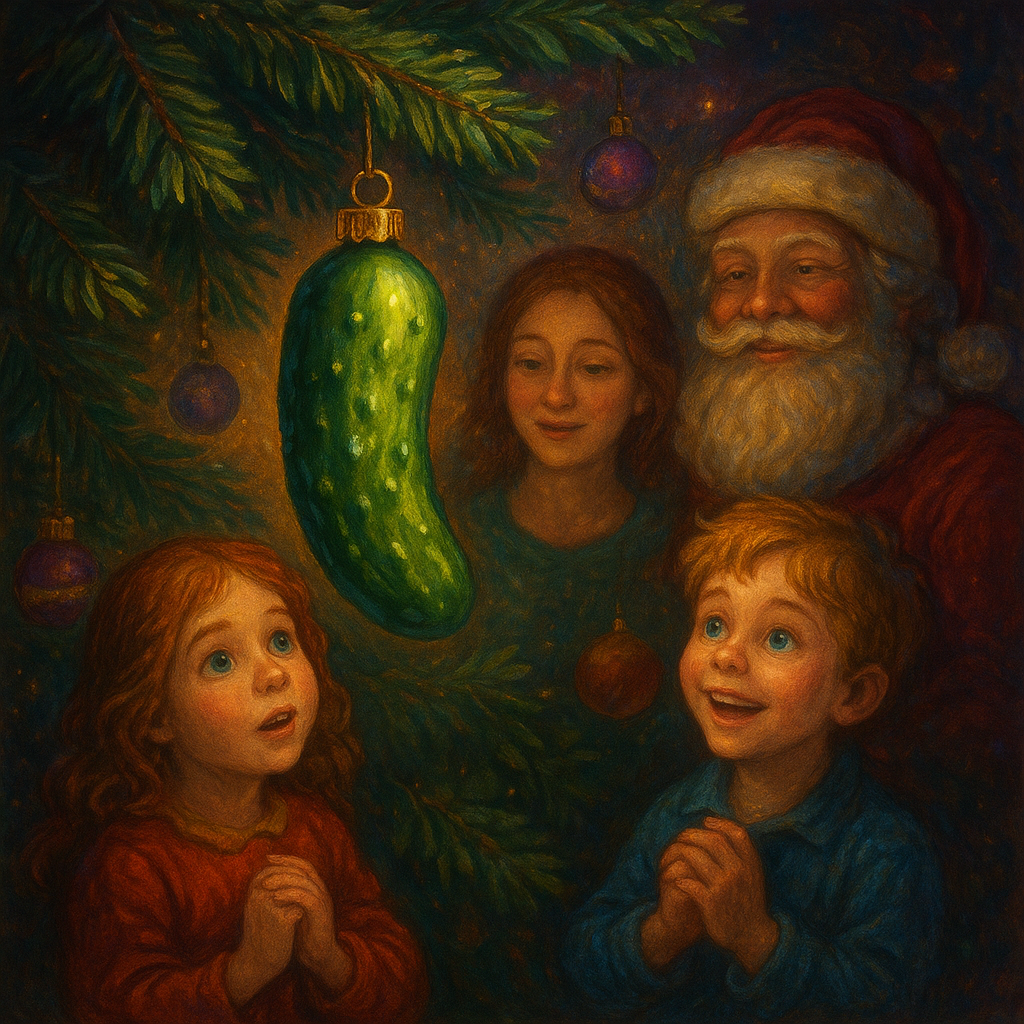
By the time most children wake up on Christmas morning, the rules are already clear: find the pickle.
Buried deep inside the branches of Christmas trees across the United States, a small, green, glass pickle waits in silence — and whoever discovers it first earns a prize. Sometimes it’s an extra gift. Sometimes it’s money. Sometimes it’s simply the glory of winning.
To outsiders, the idea sounds absurd. To families who practice it, the Christmas Pickle is as serious as Santa Claus.
And yet, its origins remain one of the most curious mysteries of American holiday folklore.
An ancient “German Tradition”
The Christmas Pickle is often described as an ancient German custom. The truth is more complicated.
Folklore researchers have long noted that the tradition is virtually unknown in modern Germany. Instead, evidence points to German-American immigrant communities in the late 19th century as the true birthplace of the custom.
Glass Christmas ornaments began arriving in the United States from Lauscha, Germany, during the 1880s. Among the decorative fruit and vegetable shapes were green glass cucumbers — visually striking, slightly absurd, and perfect for hiding in pine branches.
What started as a novelty slowly transformed into a ritual.
Families turned it into a game. Children turned it into a competition. And marketers turned it into a legend.
The Civil War Story That Wouldn’t Die
No legend survives without a great story — and the Christmas Pickle has one of the best.
According to popular folklore, a German-born Union soldier was captured during the American Civil War and held in a Confederate prison camp. Starving and close to death, he begged a guard for food. The guard gave him a single pickle.
That pickle, so the story goes, saved his life.
After the war, in gratitude, he began hiding a pickle ornament in his Christmas tree every year, gifting the finder good fortune and blessings for the year ahead.
Historians have found no hard proof of this story — but its emotional pull turned it into a permanent part of the myth.
Why a Pickle?
The choice of a pickle might seem random, but its symbolism is surprisingly meaningful.
In many European folk traditions, preserved foods symbolized:
- Survival through hard winters
- Patience and endurance
- Hidden nourishment
In that sense, the pickle becomes a metaphor for unexpected salvation — a strange object carrying quiet hope.
There is also something deeply American about it: blending humor with tradition, absurdity with sentimentality.
From Immigrant Homes to Mainstream America
By the mid-20th century, the Christmas Pickle tradition had moved from immigrant households into mainstream American culture.
Retail stores began selling official “pickle ornaments.” Newspapers ran holiday features about strange Christmas customs. Families began inventing their own rules.
Some households added:
- Money rewards
- “Good luck” promises
- Protection charms for the coming year
The pickle became more than a decoration. It became a ritual of anticipation.
What the Christmas Pickle Says About Us
The real story behind the Christmas Pickle isn’t about Germany or glass ornaments.
It’s about how traditions are born.
Not through ancient rituals — but through families, laughter, storytelling, and repetition. A joke that becomes a habit. A habit that becomes a memory. A memory that becomes a culture.
In an age of perfectly curated holiday images, the Christmas Pickle stands as a reminder that tradition doesn’t have to be serious to be sacred.
It only has to be shared.
The Quiet Magic of the Hidden Ornament
On Christmas morning, no one talks about history. They search the tree.
Hands move branches. Eyes scan needles. Laughter fills the room. And somewhere in the green chaos, a tiny pickle waits to be found.
– Not because it’s logical.
– Not because it’s ancient.
But because it makes people feel something. And sometimes, that’s all a legend really needs.
A Legacy of Mystery and Wonder – Choose another Realm…
Get Your Free Coloring Pages to print!

Unlock your creativity with our exclusive Enchanted Chronicles coloring pages to Print!
Download them now and start your magical journey!
Join our community of readers Subscribe To our newsletter!