
La Befana : The Italian Witch of Epiphany and Christmas Magic
Italy’s most mysterious Christmas legend revealed. Not all Christmas legends sparkle. Some whisper wisdom. Step into the haunting beauty of La Befana’s tale..
Elaris Windglimmer
A Timeless Folklore of Kindness, Regret, and Winter Magic
Every winter, as lights glow across Italian villages and families gather for the holidays, an ancient figure returns to the collective imagination: La Befana.
Often described as an old woman flying on a broomstick, she is neither villain nor fairy tale witch in the modern sense. Instead, La Befana stands as one of Europe’s most enduring folkloric figures—an embodiment of generosity, reflection, and the quiet magic of the season.
Rooted in centuries-old tradition, the legend of La Befana continues to enchant children and adults alike, bridging pagan rituals, Christian symbolism, and contemporary holiday celebrations.
Origins of La Befana
The origins of La Befana trace back to pre-Christian Roman traditions, particularly agricultural rites associated with the winter solstice. Ancient Romans believed that female spirits flew over fields during the twelve nights following the solstice, blessing crops for the coming year. These beliefs honored the cyclical death and rebirth of nature—an essential theme in winter folklore.
With the rise of Christianity, these pagan customs were gradually reshaped. La Befana became associated with the Epiphany, celebrated on January 6th, marking the visit of the Three Wise Men to the newborn Christ. According to legend, the Magi asked an elderly woman for directions. She refused to join them, only to regret her decision later. Carrying gifts, she set out to find the child—visiting every home along the way, leaving presents for children in hopes that one might be the Christ Child.
This fusion of pagan and Christian narratives transformed La Befana into a uniquely Italian symbol of redemption and kindness.
The Legend Retold: A Witch Who Brings Gifts
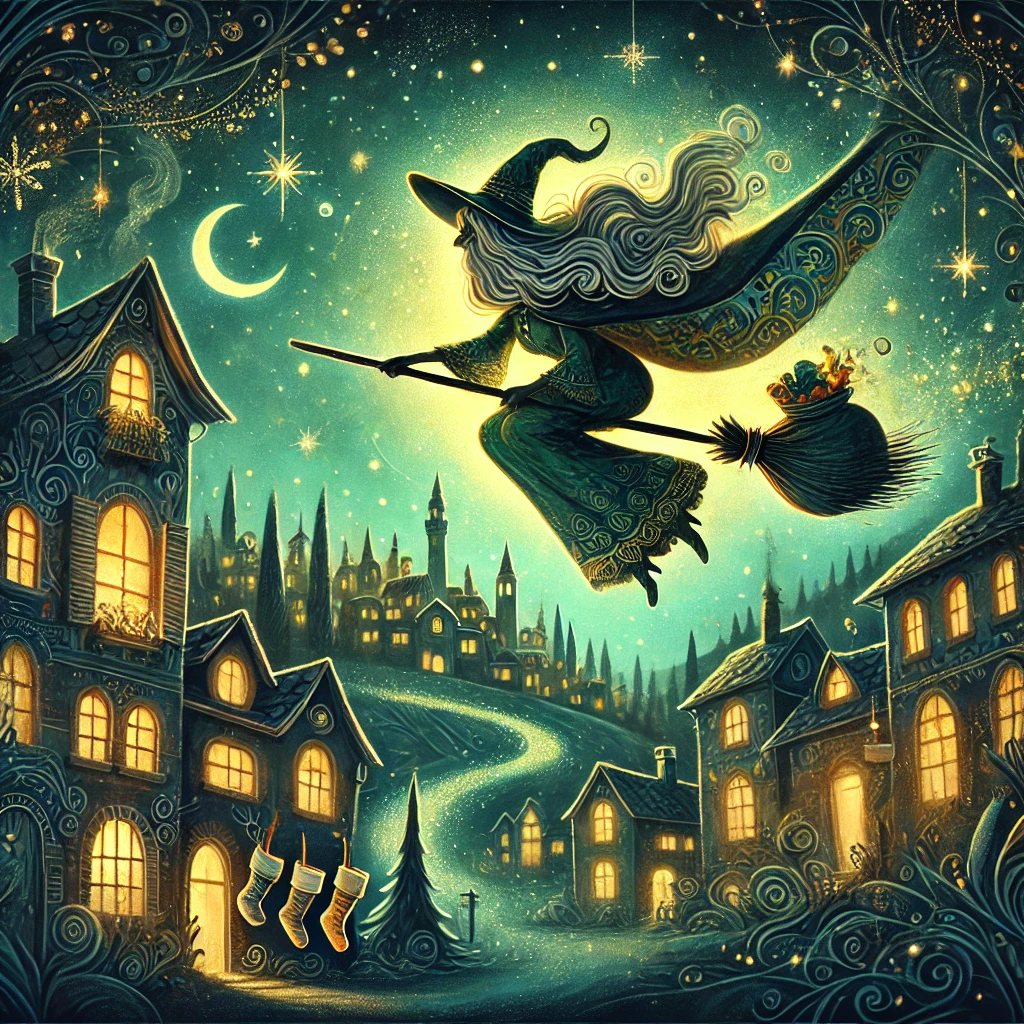
Unlike Santa Claus, La Befana does not arrive on Christmas Eve. Instead, she visits homes on the night of January 5th, riding her broom across the winter sky. Children leave stockings by the fireplace or window, hoping to receive sweets, dried fruits, or small gifts.
Well-behaved children are rewarded, while those who misbehave may find a piece of coal—often sweetened candy coal—symbolizing gentle moral guidance rather than punishment. This dual nature reinforces La Befana’s role as a maternal, watchful figure rather than a fearsome one.
Her appearance—wrinkled face, shawl, and patched dress—represents wisdom, age, and the passing year, making her a powerful symbol of transition.
Evolution Through Time: From Hearth Spirit to Cultural Icon
During the Middle Ages, La Befana became a fixture of Italian folklore, especially in rural communities. Though occasionally discouraged by church authorities, her popularity never faded. By the Renaissance, she had entered popular songs, poems, and festivals.
In modern Italy, La Befana is celebrated openly. Cities like Rome host large Epiphany markets, most famously in Piazza Navona, where artisans sell figurines, sweets, and traditional decorations. The legend has evolved from oral storytelling to literature, tourism, and visual arts, while retaining its emotional core.
La Befana in Contemporary Folklore and Culture
Today, La Befana is more than a folkloric character—she is a cultural bridge between generations. Schools, festivals, and families continue to retell her story, emphasizing values such as humility, generosity, and second chances.
She also represents a rare feminine figure in winter mythology who embodies wisdom rather than beauty, offering an alternative narrative to modern holiday icons. For many, La Befana is a reminder that magic often arrives quietly and imperfectly.
Why La Befana Still Resonates Today
In a season often dominated by commercial imagery, La Befana’s legend feels deeply human. Her story speaks to regret and redemption, reminding us that it is never too late to act with kindness.
This enduring appeal explains why La Befana continues to inspire artists, writers, and storytellers—and why she remains a cornerstone of European winter folklore.
One Final Thought
La Befana is not merely a witch or gift-bringer. She is a symbol of reflection at year’s end, a guardian of hearth and home, and a reminder that generosity transcends time. As winter deepens and the new year begins, her legend invites us all to carry a little magic forward.
Try our interactive Game
The Last Night of La Befana
The winter night is silent. Snow rests gently on the rooftops of an ancient Italian village. La Befana stands alone, holding a small sack of gifts. Once, long ago, she refused a journey… and has carried that regret ever since.
She remembers the past and hesitates She mounts her broom without looking backThe memory returns. The Wise Men. The closed door. Regret weighs heavy — but so does hope.
She chooses to knock on every door She leaves gifts silently and moves onLa Befana flies across the frozen sky. Below her, children sleep, unaware of the ancient watcher above.
She leaves gifts only where kindness livesEnding: The Path of Redemption
Every door opens. Every child receives a gift. La Befana understands at last — redemption is not found, it is given.
✨ You chose compassion.
Ending: The Silent Guardian
She leaves before dawn. No one sees her. Yet warmth lingers in every home she passed.
✨ You chose humility.
Ending: The Keeper of Balance
Not all receive gifts — but all receive a chance. Winter teaches fairness as much as mercy.
✨ You chose wisdom.