Winter Full Moon Spirits: Ancient Protection & New Year Magic
Discover the Winter Full Moon Spirits, their role in Solstice rituals, protection, divination, and how they guide the passage into the New Year.
Elaris Windglimmer
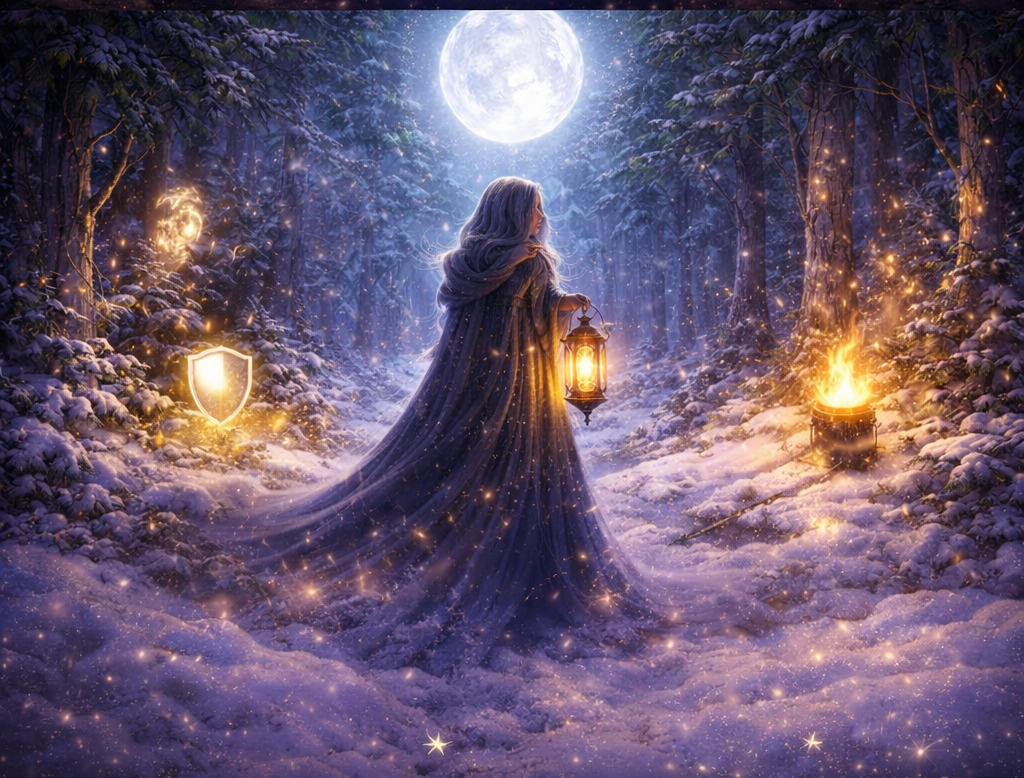
From the Winter Full Moon to the Turning of the Year
When Solstice Opens the Gate to the New Cycle
As the Winter Full Moon fades, its silver light does not disappear. It settles. It waits.
Across ancient cultures, the nights that follow the full moon of winter are believed to be threshold nights—a liminal passage between what has been endured and what is yet to begin. This is where the Solstice emerges, not as a single day, but as a corridor of transformation.
The Spirits Do Not Leave — They Transform
In Arctic, Celtic, Slavic, and Alpine folklore, the Spirits of the Winter Full Moon are said to change their nature at Solstice. No longer guardians of protection alone, they become Keepers of Alignment.
Their role shifts:
- From shielding → revealing
- From watching → guiding
- From silence → omens and signs
Old manuscripts describe them gathering at forest clearings, frozen lakes, and mountain passes on the longest night of the year. There, under a sky heavy with stars, they “unbind the year.”
“What was carried must be named. What is named can be released.”
This belief appears in Nordic Yule rites, Celtic solstice fires, and Siberian shamanic traditions, where winter spirits are invoked to close unfinished threads before the year may turn.
Solstice: The Night the World Holds Its Breath
The Winter Solstice was never only about darkness—it was about stillness.
In pre-Christian Europe, households extinguished every flame before relighting a single sacred fire. This act mirrored a cosmic truth: the world pauses so that direction can be reset.
Folklore tells us that on this night:
- Spirits walk closer to humans
- Dreams become prophetic
- Time folds inward
The Winter Full Moon Spirits are believed to stand at the edges of this pause, ensuring that nothing crosses into the new cycle unresolved.
They ask no offerings—only honesty.
The Crossing: From Solstice to New Year
After Solstice, the spirits begin to thin, not because their power fades, but because their task is complete.
In Alpine legends, this is when the spirits “fracture into sparks,” becoming:
- Household guardians
- Dream messengers
- Symbols of intention
This belief survives today in New Year customs:
- Writing wishes and burning them
- Letting go rituals
- Midnight reflections
What modern celebrations call resolutions, folklore once called bindings—promises made under unseen witnesses.
New Year: When the Spirits Return the Future
By New Year’s Eve, the spirits are no longer figures of winter—they are carriers of possibility.
In Baltic and Slavic traditions, it is said that:
- The first thought after midnight sets the year’s tone
- The first step taken shapes the path ahead
- The first light seen invites fortune or caution
The Winter Full Moon Spirits, now transformed, release what they guarded and return it to humanity—not as fate, but as choice.
Why This Legend Still Matters
In a modern world driven by speed, these myths endure because they offer something rare:
permission to pause, to release, and to begin consciously.
The journey from Winter Full Moon → Solstice → New Year is not about superstition. It is about rhythm.
And rhythm, folklore reminds us, is how humans once stayed aligned with the world.
A Whisper for the New Cycle
Before the year turns, the old stories suggest one final act:
- Stand still.
- Name what you carry.
- Release it.
- Step forward.
Try our interactive Game
🌕 The Winter Full Moon Trial
The longest night has come. The spirits are watching.
You stand beneath the Winter Full Moon.
A frozen forest surrounds you. Three paths glow faintly.