
The King without a throne
Between Christmas and Epiphany, Europe believed time broke open — and an invisible king ruled the nights.
Discover the forgotten legend of the Twelve Nights Sovereign.
Elaris Windglimmer
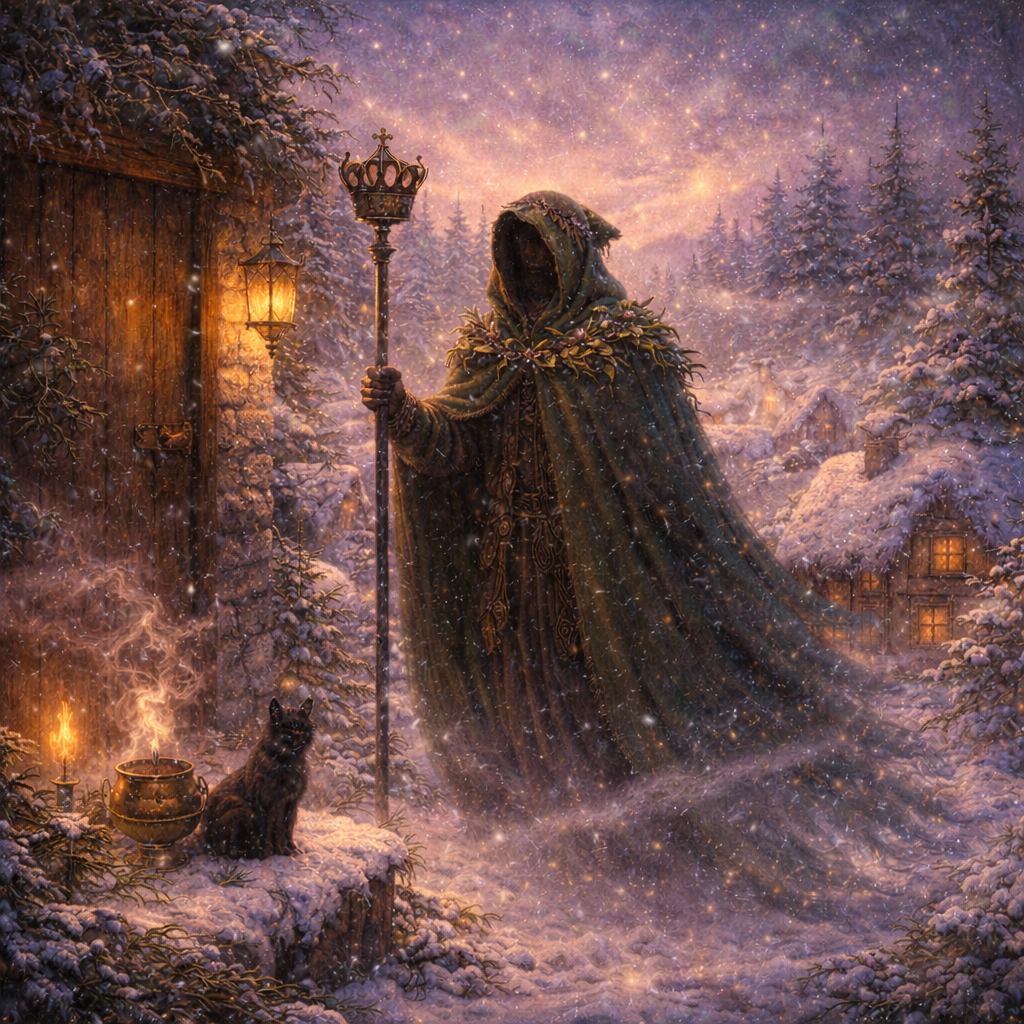
Between Christmas and Epiphany, Europe once believed the world slipped out of balance.
Between Christmas and Epiphany, there are twelve nights that were not considered ordinary days. They did not belong fully to the old year, nor yet to the new. Time thinned. Boundaries weakened. And during this fragile interval, folklore across Central Europe spoke of a ruler unlike any other…
The Twelve Nights Sovereign
An invisible king governing the liminal nights when fate, spirits, and destiny still wandered freely.
He wore no crown, held no court, and left no throne behind. Yet his presence shaped rituals, fears, and silent observances for centuries.
The twelve nights: when time loses its order…
In medieval Europe, particularly in Germanic, Alpine, and Central European regions, the period between 25 December and 6 January was considered outside of time.
These nights were known by many names:
- The Twelve Nights
- Rauhnächte (the “Rough Nights”)
- The Wild Nights
They were believed to mirror the twelve months to come. Each night held prophetic weight. Weather, dreams, and accidents were read as signs.
But beneath these practices lay a deeper belief:
during these nights, the world was not fully governed by human law.
Someone else ruled.
The invisible king of the liminal world
Unlike legendary monarchs who ruled through conquest or bloodline, the Twelve Nights Sovereign governed absence itself.
He was not seen — only sensed.
Folklore describes him as:
- A watcher of thresholds
- A judge of households
- A keeper of balance during cosmic transition
In some regions, he was believed to walk unseen through villages at night, inspecting homes, listening for noise, disorder, or disrespect for the liminal time.
Doors left unmarked. Tools used improperly. Spinning wheels turned during forbidden nights.
All were said to invite misfortune — not as punishment, but as imbalance.
The Sovereign did not punish.
He withdrew protection.
Rituals of silence and protection
To remain in harmony with the Twelve Nights Sovereign, communities practiced quiet rituals:
- Work was halted after dark
- Livestock was blessed or kept indoors
- Homes were purified with incense or smoke
- Doors were marked with chalk symbols or signs
These acts were not superstition. They were acknowledgments — gestures of respect toward a ruler whose power lay in restraint.
In this worldview, silence was loyalty. Stillness was obedience.
The wild hunt and the sovereign’s shadow
Many traditions associate the Twelve Nights with the Wild Hunt, a spectral procession crossing the winter sky
In some interpretations, the Twelve Nights Sovereign was not the leader of the hunt — but its counterbalance.
Where the Hunt represented chaos, motion, and untamed forces, the Sovereign embodied:
- containment
- stillness
- watchfulness
Together, they expressed a complete vision of winter: destruction and protection, movement and pause.
Why the soverign had to be invisible
A visible king could be challenged.
An invisible one could not.
The Twelve Nights Sovereign ruled only while unseen, because visibility would anchor him to one side of the threshold. His power depended on ambiguity — on existing between worlds.
This invisibility also placed responsibility on the people themselves.
Without a visible ruler, each household became its own guardian.
A forgotten quest for modern times
Today, the Twelve Nights pass largely unnoticed.
Yet the need they addressed remains:
- How do we close one chapter without rushing into the next?
- How do we honor transition without control?
- What happens when time demands stillness, but we refuse it?
To remember the Twelve Nights Sovereign is not to revive fear — but to reclaim intentional pause.
Perhaps the ancient quest still stands:
Can we cross the threshold without forcing it open?
The soverign’s lasting legacy
Though his name faded from memory, the Twelve Nights Sovereign shaped:
- Epiphany rituals
- Door blessings
- Winter silence traditions
- The belief that time itself must be respected
He remains one of Europe’s most powerful forgotten figures — a king whose reign depended entirely on restraint.
And perhaps that is why he still matters.
🌿 Try our Interactive Game
The Chronicle of Courage
A forgotten force flows through enchanted realms. Only those who listen deeply can awaken it.